Showing posts with label journal. Show all posts

Saturday, January 3, 2026

Enhancing the Visibility and Impact of JHRS Publications

Dear Members of the JHRS Editorial Board and Prospective Authors,

We are pleased to inform you that Issue 2, Volume 4 of the Journal of Health and Rehabilitation Sciences (JHRS) was officially published on 20th December. The issue is available at the following LINK.

Please note that the submission deadline for the forthcoming issue is 31st January.

I would like to draw your attention to the increasing importance of social media and academic networking platforms in contemporary scientific publishing. A growing body of evidence indicates that articles which are shared, mentioned, cited, and linked across social and scholarly platforms—such as Facebook, X (Twitter), LinkedIn, Mendeley, ResearchGate, Academia.edu, and similar networks—tend to achieve greater visibility and higher citation rates than those that are not actively disseminated.

I therefore kindly encourage all of you to share and promote your previously published articles in JHRS via your personal and professional online profiles. This can be done very easily: on the right-hand menu of the JHRS website, you will find social media sharing buttons that allow you to disseminate any article of interest with just one click. The entire process takes less than one minute, yet it can have a meaningful impact.

By doing so, you will contribute to:
  • increasing the visibility and citation potential of individual JHRS articles,
  • strengthening the international reach and scientific impact of the journal, and
  • enhancing the overall dissemination of research in the field of health and rehabilitation sciences.
I personally and actively promote numerous JHRS articles through both my personal and journal-related social media accounts, and I strongly believe that collective engagement will further amplify our shared success.

We are also proud to note that JHRS is indexed in several important international databases, including Scopus, EBSCO, ScienceOpen, ERIH PLUS, Hinari and more others.

Finally, we warmly encourage you to consider submitting new manuscripts to JHRS in the near future. We would be honored to receive your scholarly contributions.

Thank you for your continued support and collaboration.

With kind regards,
Editor-in-Chief
Journal of Health and Rehabilitation Sciences

Saturday, December 20, 2025

The latest issue (Vol.4, No.2, 2025) has been published

Dear Colleagues and Readers,

We are pleased to announce that Volume 4, Issue 2 of the Journal of Health and Rehabilitation Sciences (JHRS) has been published online today, December 20, 2025. This issue comprises a total of seven peer-reviewed articles. The forthcoming issue, Volume 5, Issue 1 (2026), is scheduled for publication by June 30, 2026.
 
Access to JHRS

The current issue and all published articles are available online via the journal platform. Readers, researchers, and students may access full-text PDF, HTML and XML versions of all articles without restriction. Journal of Health and Rehabilitation Sciences is an open-access, international, peer-reviewed, and non-profit journal, ensuring free and unlimited access to its scholarly content.
Citation of Articles and Use of DOI

When citing articles published in JHRS, authors are strongly encouraged to include the Digital Object Identifier (DOI) alongside standard bibliographic information. The DOI represents an international standard for persistent identification of digital content and ensures long-term accessibility, even if the article’s web location changes. Accordingly, the DOI should be used preferentially over direct URLs when referencing JHRS articles.
Online Features for Authors

By registering on the JHRS online submission system
(https://jhrs.almamater.si/index.php/jhrs/user/register), authors gain continuous access to information related to manuscript submission, review processes, and publication updates. We encourage authors and readers to disseminate JHRS publications within their academic networks and through social media platforms, thereby enhancing the visibility and impact of published research.

We warmly invite you to explore the content of Journal of Health and Rehabilitation Sciences and to consider JHRS as a venue for disseminating your scholarly work.

Call for Papers

The Call for Papers for Volume 5, Issue 1 is open until January 31, 2026.
Suggested thematic areas include:
  • Rehabilitation Research
  • Health Research
  • Special Education Research
  • Psychological Research
  • Neuropsychological Research
  • Autism Spectrum Disorders
  • Disability Research
  • Medical Aspects of Disability
  • Social Aspects of Disability
  • Master’s and Doctoral (PhD) Theses in the Field
  • Book Reviews relevant to the scope of the journal
If you have any questions or you face problems with paper submission, please feel free to contact us: editorjhrs@almamater.si. We look forward to your valuable contributions and continued engagement with JHRS.

With kind regards,
Editorial Team
Journal of Health and Rehabilitation Sciences


Tuesday, June 10, 2025

JHRS has been indexed in Scopus

 Dear Authors, Reviewers, and Editorial Board Members,

It is with great pleasure that I inform you that the Journal of Health and Rehabilitation Sciences has been officially indexed in Scopus as of today, June 10, 2025.

What is Scopus?

Scopus is a leading abstract and citation database managed by Elsevier, providing access to peer-reviewed research articles, conference papers, books, and patents across multiple disciplines, including life sciences, social sciences, physical sciences, and health sciences.

Key Features of Scopus:

  • Extensive Coverage: Indexes over 100 million records, including 25.2 million open-access documents.
  • Citation Tracking: Enables researchers to analyze citations, track academic impact, and identify influential studies.
  • Author Profiles: Supports scholars in showcasing their work and connecting with collaborators.
  • Journal Metrics: Uses indicators such as CiteScore, SJR (SCImago Journal Rank), and SNIP (Source Normalized Impact per Paper) to assess journal quality.
  • Patent Search: Includes patents from major offices such as USPTO, EPO, JPO, WIPO, and UKIPO.

    Scopus is widely used for academic research, institutional benchmarking, and strategic decision-making in scholarly publishing.

    I would like to extend my sincere gratitude to our publisher, Alma Mater Europaea University in Maribor, Slovenia, for their tremendous support in this achievement. A special thanks also goes to our authors, reviewers, editorial board members, and proofreaders, all of whom have contributed immensely over the past two years and ten months. This milestone marks a significant step forward on our pathway to future successes.

    If you are working in health, medical, or rehabilitation sciences, we warmly invite you to submit your article via the following link: Submit Here.

    Thank you for your cooperation and support.

    Best regards,
    JHRS Editor-in-Chief


Wednesday, September 4, 2024

Press release for Slovenian media

Respected journalists,

Journal of Health and Rehabilitation Sciences (JHRS) is a multidisciplinary, peer reviewed, scholarly, international, electronic journal edited by the Alma Mater Europaea University - ECM from Slovenia and Macedonian Scientific Society for Autism from Macedonia.

This journal will fill the gap, inspire scientists to exchange knowledge and experience and contribute to the development of science and the profession, due to the increase in scientific connection. With this we will increase the awareness about health care, rehabilitation processes especially for people with disabilities. Our interest is to create a journal at the highest scientific level, which is why we look forward to the cooperation of research and academic institutions in these areas. The aim of the journal is to share and disseminate knowledge between all disciplines that work in the field of developmental diversities. All articles will be critically reviewed by at least two unknown reviewers within 2 months. JHRS allows free access (Open Access) to its contents and permits authors to self-archive final accepted version of the articles on any OAI-compliant institutional / subject-based repository. We are using diamond open access model.

The subject matter is broad and includes, but is not restricted to, findings from health, psychological, biological, educational, genetic, medical, psychiatric, and sociological studies, ethical, philosophical, and legal contributions that increase knowledge on the prevention and treatment of disability, and/or inform public policy and practice.

The following articles will be considered for publication: original and review articles, short report, letters to the editor, clinical experiences, survey of cases, doctoral dissertations, master of arts, editorials, rapid communications book reviews.

Authors retain copyright of the published papers and grant to the publisher the non-exclusive right to publish the article, to be cited as its original publisher in case of reuse, and to distribute it in all forms and media. Articles will be distributed under the Creative Commons Attribution 4.0 International (CC BY 4.0) licence. Authors can enter the separate, additional contractual arrangements for non-exclusive distribution of the published paper (e.g., post it to an institutional repository or publish it in a book), with an acknowledgement of its initial publication in this journal.

Why to Publish in JHRS?
  • Editorial board has great experience in publishing;
  • Rapid publication;
  • Rapid availability of your document world-wide;
  • Studies show, that Open-Access papers are cited more than printed articles;
  • Fast and professional peer review. JHRS is run by a team of experienced editors who have previously worked in publishing. The professional editors work closely with academic editors and peer reviewers to provide authors with an efficient, fair, and constructive review process;
  • Quick review: The review decision will be made within two months from the date of submission.
  • Indexing of your document which can be easily found in library catalogs, OAI archives and search engines on the net.
  • Not for profit journal;
  • Liberality in terms of language: The journal will not reject a paper merely based on the language. The authors will be guided to improve the manuscript in such case.
  • We have no page charges or submission fees, and you have free use of color figures.
  • Our mission is to advance excellence in the social sciences and humanities, and our status as a scholarly publisher allows us to focus on making that a reality. We re-invest all surplus back into the global scientific community, providing ongoing support for authors, researchers, and educators in every field of health and rehabilitation sciences, psychology, and related disciplines.
This August, Journal of Health and Rehabilitation Sciences celebrates two years of its existence. We spent two productive years fulfilled with a lot of challenges. We published 26 articles in 4 issues, with more than 46.200 page visits. JHRS is indexed in 42 databases, which is a great number. Editorial board is consisting with members from 21 world countries.

If you want to see the short presentation about our achievements, please visit this LINK.

The video about our activities you can find on JHRS YouTube channel.

Authors from Slovenia are kindly invited to submit an article in our JHRS. The style of referencing is from APA. The deadline for sending the manuscripts is September 30th, 2024.

With respect,
JHRS Editor-in-chief


Thursday, August 1, 2024

JHRS two years with you

Dear authors, reviewers, readers,

Today, August 1st, Journal of Health and Rehabilitation Sciences celebrates two years of its existence. We spent two productive years fulfilled with lot of chanllenges. We published 26 articles in 4 issues, with around 45.000 page visits. JHRS is indexed in 41 databases which is a great number. JHRS is in the evaluation  procedure in Scopus, we hope for inclusion. Editorial board is consist with members from 21 world countries.

If you want to see the short presentation about our achievments, please visit this LINK.

The video about our activities you can find on JHRS YouTube channel. Please watch it here:


I thank everyone who made a greater or lesser contribution to the development of the journal.

Cheers,
JHRS Editor-in-chief 


Wednesday, November 22, 2023

Five new indexing in JHRS

Dear colleagues,

I want to inform you that Journal of Health and Rehabilitation Sciences is already indexed in five new databases. They are:

  • COBISS.MK
  • DeepDyve
  • Internet Archive
  • Scilit
  • Sudoc

  • So in this moment JHRS is indexed in 31 databases.
    Cheers,
    JHRS Editor-in-chief

    Wednesday, October 4, 2023

    Call for papers Vol. 2, Issue 3, 2023

    Respected colleagues, and readers

    Journal of Health and Rehabilitation Sciences (JHRS) is a multidisciplinary, peer reviewed, scholarly, international, electronic journal. The following articles will be considered for publication: original and review articles, short report, letters to the editor, clinical experiences, survey of cases, doctoral dissertations, master of arts, editorials, rapid communications and other contributions from all the fields of health sciences, rehabilitation sciences, developmental diversities, special education, psychology, social policy, and the related sciences. 
    The aim of the journal is to share and disseminate knowledge between all disciplines that work in the field of developmental diversities. All articles will be critically reviewed by at least two unknown reviewers within 2 months, but longer delays are sometimes unavoidable. All manuscripts must comply with Authors Instructions. There will be around 20 articles published per year. 
    JHRS allows free access (Open Access) to its contents and permits authors to self-archive final accepted version of the articles on any OAI-compliant institutional / subject-based repository. Journal of Health and Rehabilitation Sciences is devoted to the scientific study of health disturbances and rehabilitation. The subject matter is broad and includes, but is not restricted to, findings from health, psychological, biological, educational, genetic, medical, psychiatric, and sociological studies, ethical, philosophical, and legal contributions that increase knowledge on the prevention and treatment of disability, and/or inform public policy and practice.

    You are kindly invited to submit an article in our Journal. Please type them in Word format. Please use Times New Roman font with Font size 12. The manuscript can not exceed 30.000 characters with no spaces A4 format including Abstract, Tables, Figures, and References. The margins should be 2 cm from every side, and also paragraph should be 1.5 lines. The style of referencing is from APA.
    You can send the articles on the following the electronic system. Registration on OJS platform is HERE.
    The dead line for sending the manuscripts is October 31st 2023.


    With respect,
    JHRS Editor-in-Chief

    Wednesday, August 2, 2023

    JHRS indexed in ScienceOpen

    Dear readers,

    With great pleasure I want to inform you that Journal of Health and Rehabilitation Sciences is indexed in ScienceOpen.

    What is ScienceOpen?

    ScienceOpen is a discovery platform with interactive features for scholars to enhance their research in the open, make an impact, and receive credit for it. We provide context building services for publishers, to bring researchers closer to the content than ever before. Our advanced search and discovery functions, combined with post-publication peer review, recommendation, social sharing, and collection-building features make ScienceOpen the only research platform you’ll ever need.

    In this occasion I would like to thank to the staff of ScienceOpen.com, especially to Nina and Stuart for their efforts and unselfish support to our journal.
    Cheers,
    JHRS Editor-in-chief


    Tuesday, August 1, 2023

    One year of Journal of Health and Rehabilitation Sciences

    Dear readers, respected authors and reviewers,

    Today, August 1, 2023 marks exactly one year since I was appointed Editor-in-Chief of the Journal of Health and Rehabilitation Sciences. The publisher of the journal is Alma Mater Europaea - ECM from Maribor, Slovenia, and immediately after its establishment, the Macedonian Scientific Society for Autism joined. I must admit that this was a great validation of my previous more than 20 years of efforts as editor-in-chief of the Journal of Special Education and Rehabilitation and Journal for ReAttach Therapy and Developmental Diversities in which I selflessly invested my labor and knowledge in academic publishing. For this first birthday, we prepared a pamphlet for which I thank the editor's assistant Andrea Ivanovska for the technical preparation of it. Web administrator Blagoja Janevski, with whom we work day and night to improve the functionality of the website, update new information, etc., certainly deserves thanks. In the end, the highlighters, Prof. Dr. Ludvik Toplak and Assoc. prof. Sebastjan Kristovič who immediately accepted my idea for this new journal and selflessly invest financial resources from AMEU in the development of this new electronic journal. From the other technical and administrative staff of AMEU I am thankful to Tomaž Klojčnik, Uroš Kugl and Špela Pokeržnik.

    The journal by the numbers for one year:

    • 15 papers already published,
    • 25300 visits to the website,
    • Indexed in 20 databases,
    • 24 authors,
    • 40 reviewers,
    • 32 members of the editorial board from 21 countries,
    • Papers from USA, Australia, Ireland, Hungary, Slovenia, Croatia, Bosnia and Herzegovina, Serbia and Macedonia.

    We continue with much passion, love and dedication to build this international magazine. The idea is to be read, quoted, indexed as much as possible and to attract attractive authors from all over the world. If you are interested in seeing our year-long growth, please visit the website at the link above and the magazine's blog. We are inviting you to submit your paper HERE.

    May we have a happy first birthday on the eve of the great Macedonian national holiday ILINDEN!

    JHRS Editor-in-Chief 


    Sunday, July 2, 2023

    Journal of Health and Rehabilitation Sciences - promo

    Journal of Health and Rehabilitation Sciences (JHRS) is a multidisciplinary, peer reviewed, scholarly, international, electronic journal edited by the Alma Mater Europaea University - ECM from Slovenia and Macedonian Scientific Society for Autism from Macedonia.
    This journal will fill the gap, inspire scientists to exchange knowledge and experience and contribute to the development of science and the profession, due to the increase in scientific connection. With this we will increase the awareness about health care, rehabilitation processes especially for people with disabilities. Our interest is to create a journal at the highest scientific level, which is why we look forward to the cooperation of research and academic institutions in these areas.

    It is established on August 1st 2022, biannually journal, with tendency for publishing issues 3 times per year.
    The aim of the journal is to share and disseminate knowledge between all disciplines that work in the field of developmental diversities.

    The following articles will be considered for publication: original and review articles, short report, letters to the editor, clinical experiences, survey of cases, doctoral dissertations, master of arts, editorials, rapid communications and other contributions from all the fields of health sciences, rehabilitation sciences, developmental diversities, special education, psychology, social policy, and the related sciences. All articles will be critically reviewed by at least two unknown reviewers within 2 months, but longer delays are sometimes unavoidable. All manuscripts must comply with Authors Instructions. There will be around 20 articles published per year. JHRS allows free access (Open Access) to its contents and permits authors to self-archive final accepted version of the articles on any OAI-compliant institutional / subject-based repository. Journal of Health and Rehabilitation Sciences is devoted to the scientific study of health disturbances and rehabilitation. The subject matter is broad and includes, but is not restricted to, findings from health, psychological, biological, educational, genetic, medical, psychiatric, and sociological studies, ethical, philosophical, and legal contributions that increase knowledge on the prevention and treatment of disability, and/or inform public policy and practice.

    Peer review process is unbiased, independent, critical assessment is an intrinsic part of all scholarly work, including scientific investigation. Peer reviewers are experts in their field who are not part of the editorial staff and thus are an important extension of the scientific process. Manuscripts will be reviewed by at least 2 reviewers. Peer reviewers are asked to submit their review within two (2) weeks. All randomized controlled trials will be fast-tracked through the peer-review and editorial process and we will endeavor to publish accepted trials within 2 weeks of final acceptance.

    Journal of Health and Rehabilitation Sciences is an open access journal. All its content is available free of charge. Users can read, download, copy, distribute, print, search the full text of articles, as well as to establish HTML links to them, without having to seek the consent of the author or publisher. The journal does not charge any fees at submission, reviewing, and production stages. It uses Diamond Open Access model. Journal of Health and Rehabilitation Sciences applies the Creative Commons 4.0 International License to works we publish, because we believe that there should be no financial barriers to access to information that can benefit health and medical practice.
    Authors can deposit author’s preprint, author’s postprint (accepted version) and publisher's version (PDF) of their work in an institutional repository, subject-based and general-purpose repository, author's personal website (including social networking sites, such as ResearchGate, Academia.edu, etc.), and/or departmental website prior or during the submission process, at any time after the acceptance of the manuscript and at any time after publication.
    Full bibliographic information (authors, article title, journal title, volume, issue, pages) about the original publication must be provided and links must be made to the article's DOI and the license.


    Why to Publish in JHRS?
    • Editorial board has great experience in publishing;
    • Rapid publication;
    • Rapid availability of your document world-wide;
    • Studies show, that Open-Access papers are cited more than printed articles;
    • Fast and professional peer review. JHRS is run by a team of experienced editors who have previously worked in publishing. The professional editors work closely with academic editors and peer reviewers to provide authors with an efficient, fair, and constructive review process;
    • Quick review: The review decision will be made within two months from the date of submission.
    • Indexing of your document which can be easily found in library catalogs, OAI archives and search engines on the net.
    • Not for profit journal;
    • Liberality in terms of language: The journal will not reject a paper merely based on the language. The authors will be guided to improve the manuscript in such case.
    • We have no page charges or submission fees, and you have free use of color figures.
    • Our mission is to advance excellence in the social sciences and humanities, and our status as a scholarly publisher allows us to focus on making that a reality. We re-invest all surplus back into the global scientific community, providing ongoing support for authors, researchers, and educators in every field of health and rehabilitation sciences, psychology, and related disciplines.
    JHRS asks that all authors submitting a paper register an account with Open Researcher and Contributor ID (ORCID). ORCID identifiers for all authors and co-authors should be added to the author data upon submission and will be published alongside the submitted paper, should it be accepted. ORCID registration provides a unique and persistent digital identifier for the account that enables accurate attribution and improves the discoverability of published papers, ensuring that the correct author receives the correct credit for their work.
    Please note that all submissions are thoroughly checked for plagiarism. JHRS uses Turnitin software for similarity checks.
    Any manuscript that shows obvious signs of plagiarism will be automatically rejected.
    In case plagiarism is discovered in a paper that has already been published by the journal, it will be retracted in accordance with the procedure described below under Retraction policy, and authors will be punished to have no another opportunity to submit an manuscript in JHRS.
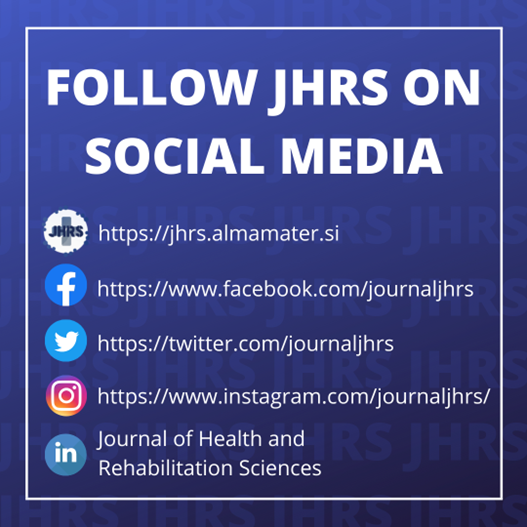
    JHRS is measuring the journal statistics because it is a very good way to advertising the journal. We are using social media to increase the visibility and citation of our articles.

    Contact JHRS

    Alma Mater Europaea University
    Slovenska 17, 2000 Maribor,
    Slovenia
    Phone: +386-2-2501997; +389-2-3116-520 (234)

    Saturday, March 18, 2023

    Saturday, March 11, 2023

    JHRS promotion at AMEU conference

    We are delighted to inform you that our Editor-in-Chief Prof. Dr. Vladimir Trajkovski will be presenting the Journal of Health and Rehabilitation Sciences during the "It's About People" conference organized by Alma Mater Europaea - ECM. The Journal promotion is scheduled for Saturday, March 11, 2023, at 16:00 CET, and can be accessed via the following LINK. The session will be moderated by Dr. Polonca Pangrčič.
    Your support and engagement in this promotion would be greatly appreciated.
    Thank you for your continued dedication and commitment to the Journal of Health and Rehabilitation Sciences.


    Sunday, February 26, 2023

    Retraction policy

    The infringement of the legal limitations of the publisher, copyright holder or author(s), the violation of professional ethical codes and research misconduct, such as multiple submissions, duplicate or overlapping publication, bogus claims of authorship, plagiarism, fraudulent use of data and data fabrication, honest errors reported by the authors (for example, errors due to the mixing up of samples or use of a scientific tool or equipment that is found subsequently to be faulty), unethical research or any major misconduct require retraction of an article. Occasionally a retraction can be used to correct errors in submission or publication. The main reason for withdrawal or retraction is to correct the mistake while preserving the integrity of science; it is not to punish the author.

    For any retracted article, the reason for retraction and who is instigating the retraction will be clearly stated in the Retraction notice. Standards for dealing with retractions have been developed by a number of library and scholarly bodies, and this practice has been adopted for article retraction by Journal of Health and Rehabilitation Sciences: in the electronic version of the retraction note, a link is made to the original article. In the electronic version of the original article, a link is made to the retraction note where it is clearly stated that the article has been retracted. The original article is retained unchanged, save for a watermark on the PDF indicating on each page that it is “retracted.”

    Monday, January 23, 2023

    How to establish electronic, scholarly, open access and peer-reviewed journal in small country

    Institute of Special Education and Rehabilitation, Faculty of Philosophy, University "Ss. Cyril and Methodius", Skopje, Macedonia

    ABSTRACT

    Introduction: publishing an electronic, peer-reviewed, open-access academic journal in a small country is really hard work. The advancement of electronic journals during recent years has given professionals in academia a powerful new tool to support learning and research.
    The purpose of this article is to provide some guidelines about creating electronic, scholarly, open access and peer-reviewed journal in small country through the example of Journal of Health and Rehabilitation Sciences.
    Methods: An analysis of relevant literature, sources from the Internet and published literature, personal experience and observations of the author as editor-in-chief in two similar journals previously.
    Findings: a new modern academic journal should be open access, peer-reviewed, with international editorial board, having staff who work very dedicatedly. The journal should be set it up on OJS platform, using Creative Commons license for authors and DOI numbers for the articles. Plagiarism detection is a prevention of publication ethics violation. Journal editors should make additional efforts to index journal in lot of scholarly databases and to intend to increase the visibility. Sharing journal content on social media has become an important instrument and platform for editors and researchers as well.
    Conclusions: Journal of Health and Rehabilitation Sciences (JHRS) is a multidisciplinary peer reviewed, international, electronic journal. Editorial office expects your submitted articles in the following weeks and months.

    Keywords: electornic, scholarly, open access, peer-review, journal, JHRS, small country

    Saturday, January 21, 2023

    Call for Papers Vol.2, Issue 1, 2023

    Respected colleagues,

    Journal of Health and Rehabilitation Sciences (JHRS) is a multidisciplinary, peer reviewed, scholarly, international, electronic journal. The following articles will be considered for publication: original and review articles, short report, letters to the editor, clinical experiences, survey of cases, doctoral dissertations, master of arts, editorials, rapid communications and other contributions from all the fields of health sciences, rehabilitation sciences, developmental diversities, special education, psychology, social policy, and the related sciences. 
    The aim of the journal is to share and disseminate knowledge between all disciplines that work in the field of developmental diversities. All articles will be critically reviewed by at least two unknown reviewers within 2 months, but longer delays are sometimes unavoidable. All manuscripts must comply with Authors Instructions. There will be around 20 articles published per year. 
    JHRS allows free access (Open Access) to its contents and permits authors to self-archive final accepted version of the articles on any OAI-compliant institutional / subject-based repository. Journal of Health and Rehabilitation Sciences is devoted to the scientific study of health disturbances and rehabilitation. The subject matter is broad and includes, but is not restricted to, findings from health, psychological, biological, educational, genetic, medical, psychiatric, and sociological studies, ethical, philosophical, and legal contributions that increase knowledge on the prevention and treatment of disability, and/or inform public policy and practice.

    You are kindly invited to submit an article in our Journal. Please type them in Word format. Please use Times New Roman font with Font size 12. The manuscript can not exceed 30.000 characters with no spaces A4 format including Abstract, Tables, Figures, and References. The margins should be 2 cm from every side, and also paragraph should be 1.5 lines. The style of referencing is from APA.
    You can send the articles on the following the electronic system. Registration on OJS platform is HERE.
    The dead line for sending the manuscripts is February 28th 2023.


    With respect,
    JHRS Editor-in-Chief

    Sunday, January 15, 2023

    JHRS newest issue 1, Volumen 1 for 2022 has already been published

    Dear colleagues and readers,

    I would like to inform you that 1st issue of the 1st volume of Journal of Health and Rehabilitation Sciences is published online today (January 15th, 2023). A total number of 6 papers are published. Next Issue 1, Vol. 2 of JHRS for the 2023 is expected to be published until April 30th, 2023.

    Accessing JHRS Online
    To view a current articles which appears online, please visit this LINK.
    You, your colleagues, and students will be able to view articles (Full-Text PDF and XML) and have unlimited access to the journal (JHRS is an open access, international, peer reviewed and non for profit journal).

    Citing Articles Using the Digital Object Identifier (DOI)
    When citing articles from JHRS, we encourage you to use article’s DOI in addition to traditional citation information. This is an industry standard, a link-resolving system that allows any link to remain “persistent” even if the location of the article changes at some point in the future. Hence, when you are quoting the link for an article, you should always quote the DOI rather than the URL of our home page.

    Useful Online Features for Authors
    Your registration in online submission (https://jhrs.almamater.si/index.php/jhrs/user/register) will enable you with continuous information connected with JHRS. We encourage you to share publications from JHRS platform and online registration with your colleagues. You can feel free to share every publication on social media.
    We invite you to the content of the JHRS and we think that you will consider publishing with Journal of Health and Rehabilitation Sciences.

    Call for papers for Vol.2, Issue 1 is open until February 28th.

    Suggested topics include:

    Rehabilitation Research,
    Health Research,
    Special Education Research,
    Neuropsychological Research,
    Autism Spectrum Disorders,
    Medical Aspects of Disability,
    Social Aspects of Disability,
    Master theses and PhD theses in the field,
    Book Reviews in the field.


    If you have any questions or you face problems with paper submission, please feel free to contact us: editorjhrs@almamater.si


    Cheers,

    JHRS Editor-in-chief


    Monday, January 9, 2023

    Paper Promotion Tips

    How to Promote Your Article after It Is Published

    Congratulations on the publication of your article. Promoting your work is an important part of the post-publication process which will increase the visibility, impact and citation of your work. JHRS will support you to promote your research papers within your scientific community, as well as to a wide audience.

    What You Can Do to Promote Your Article
    Social Media


    Share your article on various social networks, such as Facebook, LinkedIn, Mendeley, Instagram and Twitter by clicking the link on the webpage of your article. Tagging @journaljhrs as well as key people in your field might lead to retweets: Your publication may become viral on social media!
    Send a short text (up to 200 characters) to the JHRS editorial assistant who was your contact for the publication of your manuscript, and she will then post it on the Journal Instagram and Twitter account.
    Write a blog post to explain the meaning and possible outcomes of your research. This will lead to higher engagement of your research community.
    Ask your institution or society to post your paper on their social media accounts and to include a story about your paper in their newsletters.
    Link ShareShare the article link directly with colleagues and peers in your field.
    Add a link to your article in your email signature.
    Update your personal and institutional websites by adding the title of your article and a link to it.
    Academic Research-sharing PlatformsSet up your profile on academic research-sharing platforms, such as ResearchGate, Academia.edu, or Google Scholar, and add a short summary of your article.
    Register an ORCID author identifier and add the article information to your profile.
    Deposit your article to repositories (such as those run by your university) to make your research more discoverable.
    ConferencesPresent your publication at conferences in the form of a presentation or a poster. You may participate in conferences relevant for your field.
    VideoProduce a video abstract that briefly introduces your article.
    WikipediaFind a Wikipedia page on a topic related to your article and add a reference to your paper.

    What We Do to Promote Your Article

    JHRS takes a number of actions to promote and increase the visibility of your research articles.
    High Visibility


    All articles are immediately available worldwide under an open access license to maximize visibility.
    Indexing databases receive article information from JHRS to increase readership and citations. We collaborate with Scopus, EBSCO, DOAJ and many others.
    Editors and reviewers are notified as soon as your paper is published.
    Articles are listed in the journal’s Table of Contents Alerts and sent to regular subscribers.
    Selected articles are reprinted for their promotion at conferences and other events.
    Partnering OrganizationsMetadata and other information are passed on to partnering organizations, including CrossRef, ORCID, and Publons.
    Multiple Formats for Article Multiple formats are available for each article, including machine-readable XML, and PDF.

    Wednesday, November 9, 2022

    Register with ORCID

    Dear JHRS author,

    Before you submit your article you should be registered on ORCID platform. There are 3 steps: 1. Personal data, 2. Security and Notifications, 3. Visibility and Terms. More about registration you can find on this video. All JHRS authors should have ORCID id.

    About ORCID

    ORCID, which stands for Open Researcher and Contributor ID, is a global, not-for-profit organization sustained by fees from our member organizations. We are community-built and governed by a Board of Directors representative of our membership with wide stakeholder representation. ORCID is supported by a dedicated and knowledgeable professional staff.

    JHRS Editor-in-chief

    Wednesday, November 2, 2022

    Journal indexing: Understanding the basics

    In order to be known as an authoritative source of scientific information, and to stand out from among many other publications that are crowding the publishing space, journals must increase their visibility, availability, and readership. One of the ways by which journals can achieve this is by getting their publication indexed by one or more leading databases.

    Why is indexing essential?Indexing will help your journal achieve its main purpose of being accessible to a wide audience.
    Being accessible in turn will improve your journal’s reputation as a reliable source of high-quality information in your field.
    Database research is the first activity researchers undertake as part of their study, and they naturally look to established, well-known databases. Thus, being indexed in a known database in your field will help increase your journal’s readership.

    How does indexing work?
    Once a journal is indexed by a database, it is immediately made available to all users of that database. Some databases index titles, some index full articles while some others index only the abstract and/or references. There are several abstracting and indexing services available today. Some are affiliated with institutions (e.g., PubMed maintained by the United States National Library of Medicine at the National Institute of Health) while some are provided by publishers (e.g., Scopus by Elsevier). Irrespective of which institution the database is affiliated with, you will need to formally apply for inclusion in the database of your choice.

    How should you go about getting your journal indexed?
    Choose the right database!
    Just as journal editors do not consider manuscripts that lie outside the scope of their journal, indexing companies do not consider journals that lie outside their scope. Choose a database that indexes journals from your field. It is also important to understand the features the database provides. Some databases only index abstracts, where users will be able to view relevant abstracts of articles published in your journal. Some get professional indexers to scan entire manuscripts and index keywords. Some others also include citations in their indexing system. Knowing how exactly your journal will be visible and accessible to the user will also help you choose the right journal indexing database. Detailed information about how the database works will be included on its web page.

    Understand the selection process followed by the database you have chosen!
    Some general criteria that databases use to evaluate a journal’s suitability for indexing are quality of content published, publishing timeliness, and journal workflow and processes. Typically, to get indexed, a journal has to submit a formal application to the database and provide relevant documents and evidence supporting its application. If the journal meets all criteria, it gets indexed. The process of getting indexed is similar to manuscript submission and peer review: journals submit their documents and wait for their application to be reviewed by the database. If your journal does not meet the criteria required for indexing, you may need to introduce some changes in your journal workflow to make sure that your journal is eligible.

    Ensure your journal processes are smooth and efficient!
    Make sure your journal meets the basic publication standards required by the industry (author friendly systems, smooth and timely peer reviews, easy accessibility, etc.). In your application it should be clear that your journal is worthy of being indexed by the database you choose.

    Approach a company with multiple databases!
    Companies like Elsevier and Thomson Reuters offer several indexes that cater to journals. In such cases, it might be a good idea to check the full list of products or services offered and apply to those that are relevant to your journal.

    Where should you get indexed?
    As we advised the journal Clinical Endoscopy, it is essential to choose an indexing company/database that is in line with your journal’s scope. Here’s a list of common databases you could explore.Scopus: Managed by the publishing company Elsevier, Scopus indexes journals from the fields of science, technology, medicine, social sciences, and arts and humanities. It also provides research analysis and tracking tools.
    EMBASE (Excerpta Medica database): Also maintained by Elsevier, EMBASE is a biomedical database accessed by researchers, information managers, regulatory specialists, clinicians, medical librarians, educators and physicians. (Elsevier maintains other databases such as EMcare and Engineering Village.)
    PubMed: Maintained by the United States National Library of Medicine, PubMed covers biomedical literature from life science journals, and online books. It also accesses the MEDLINE bibliographic database of reference and abstracts.
    SCIE (Science Citation Index-Expanded): SCIE is a product by Thomson Reuters. It covers journals from a range of scientific and technical fields. It also provides some data analysis options.
    BIOSIS Citation Index: Also by Thomson Reuters, BIOSIS covers a range of biological and biomedical sciences.
    DOAJ (Directory of Open Access Journals): DOAJ is an online directory that indexes and provides access to open access, peer-reviewed journals covering history, religion, geography, language and literature, etc.
    Ovid: Ovid is a branch of Wolters Kluwer. Ovid databases cover a wide range of topics including clinical medicine, pharmacology.
    EBSCO Information Services: The EBSCO database includes titles compiled by the company as well as journals from other databases/publishers such as Medline and EconLit. The company also maintains Academic Search Complete, which covers the full-text of journals.
    BioOne Abstracts and Indexes: These provide access to peer-reviewed research in the biological, ecological, and environmental sciences.
    Additional lists:
    To compare one or more databases at once, you could also check the lists below:

    Source: https://www.editage.com/

    The Interplay of Patient Demographics, Pain and Quality of Life in Chronic Low Back Pain Management Through Physiotherapy

    Helena Blažun Vošner   Community Health Center dr. Adolf Drolc, Maribor, Slovenia  https://orcid.org/0000-0003-1998-7346 Jernej Završnik   C...